Should Global Markets Have One Physical Center?
You can break it down into two core issues.
Market Structure
The Total Addressable Market of Global Finance
Lets talk about market structure first because I think its actually the more important one, because this directly translates into better products.
Market Structure
It should be no surprise to anyone that has studied the financial system that over time as we moved from paper trading to electronic trading, systems got faster. As a result, physical proximity to the matching engine gave trading firms a unique advantage from being physically colocated in the same data center or having a direct fiber link to the matching engine.
If you haven't gone down this rabbit hole, I encourage you to read the history of Flash Boys. There is a reason trading firms spend so much money optimizing networks, microwave links and private fiber lines, because milliseconds in latency can translate into billions of dollars.
NYSE even normalizes fiber lengths for the same connection service inside its Mahwah data center, regardless of which hall or cabinet a firm uses. The goal is to remove the advantage of simply having a closer rack. This is described in ICE’s colocation specifications.
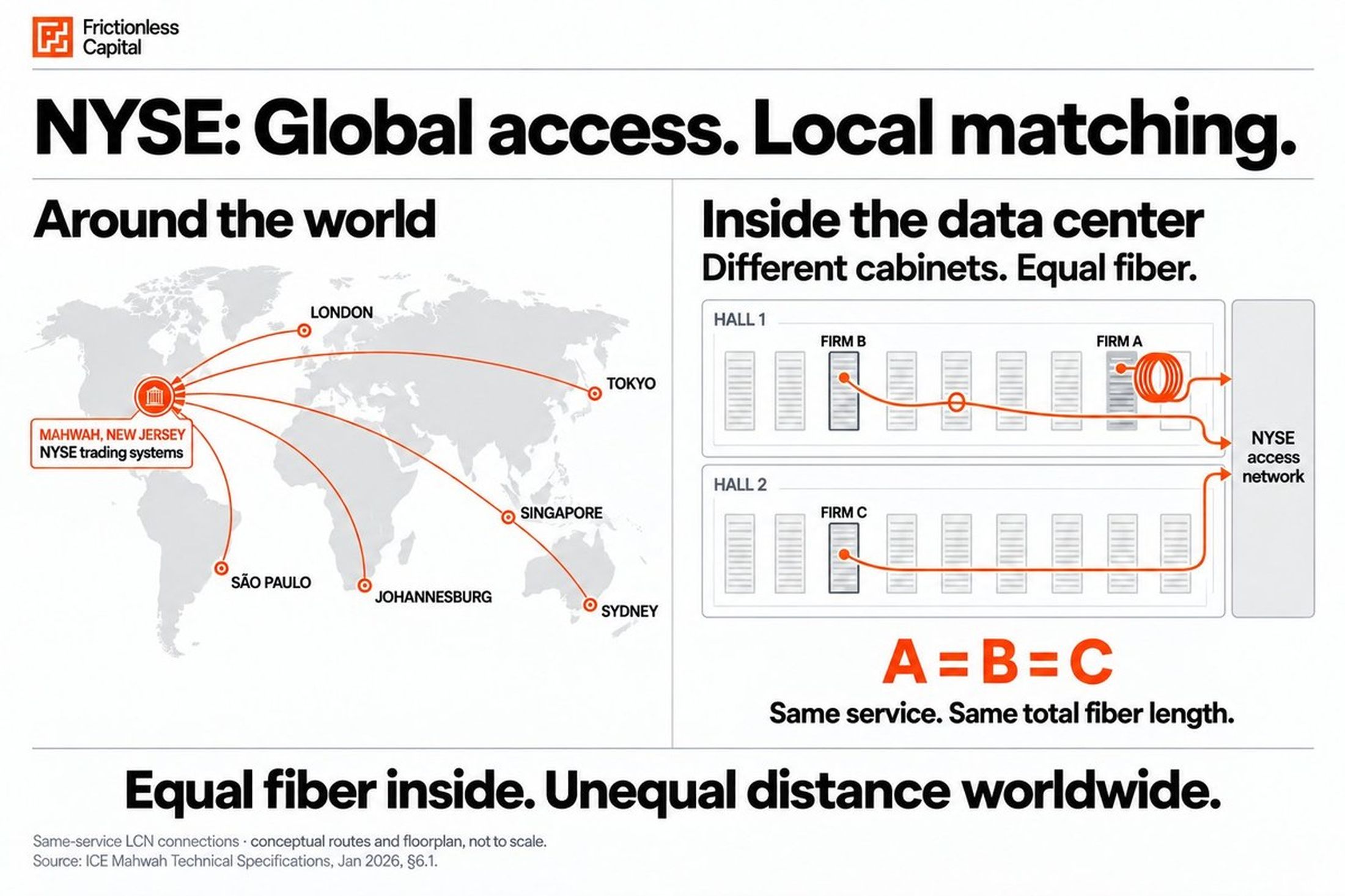
Equal-length fiber within the same connection service. Global distances and latency remain unequal.
But equal fiber inside the building doesnt mean equal distance from everywhere in the world.
A trading firm in Tokyo still has a much longer physical path to Mahwah than a firm already inside the data center.
When you start examining the current landscape of blockchain trading products you start to see a similar landscape play out.
Arbitrum introduced Timeboost where firms bid for an express lane, while MegaETH plans Proximity Seats (see below) where firms would reserve server space near the sequencer.
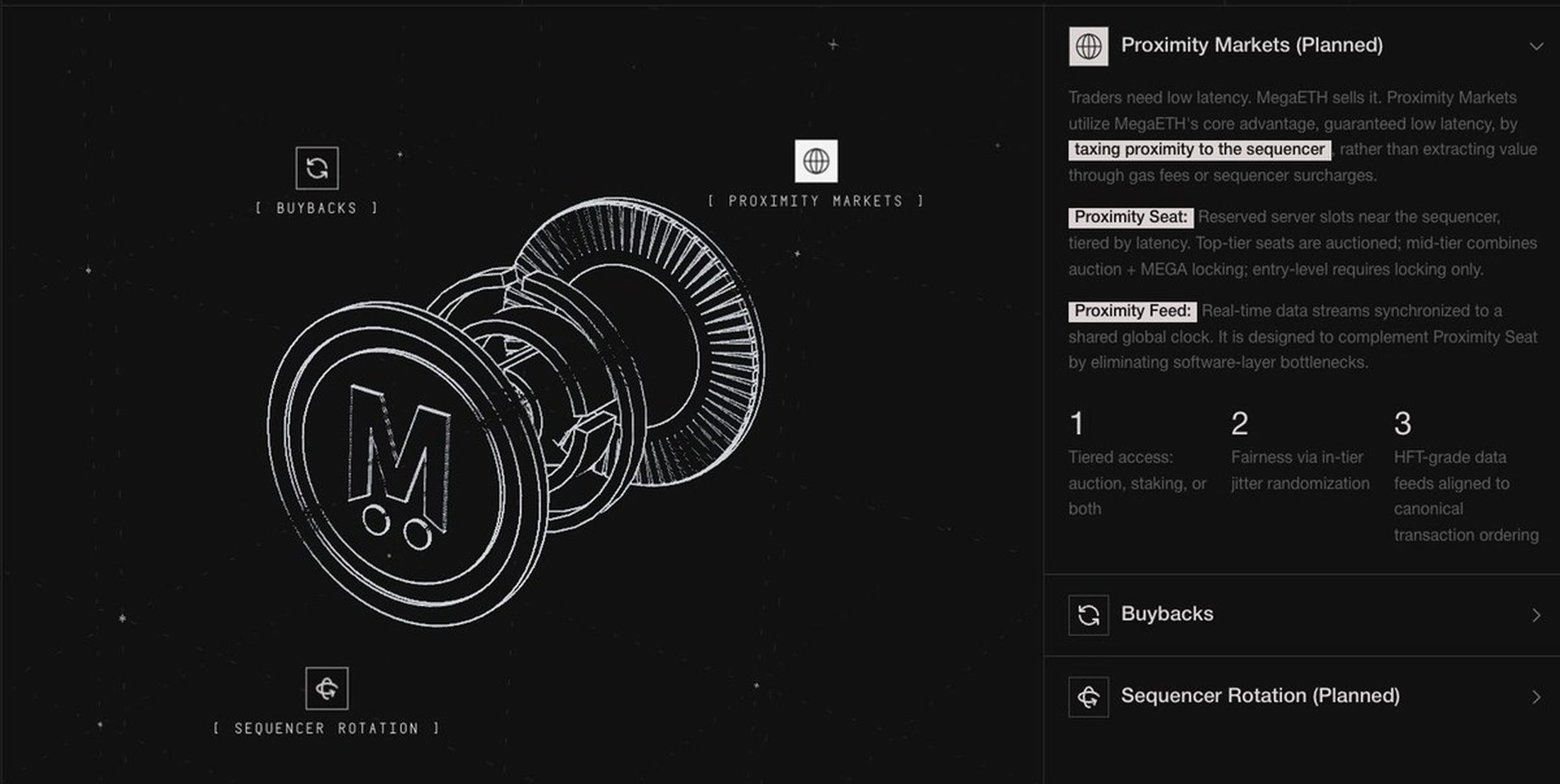
See https://www.megaeth.com/token and scroll for Proximity Seats
Glassnode identifies both Robinhood Chain’s et Arbitrum One’s sequencers as being in Ohio. Base also uses a centralized sequencer that appears to be near Ashburn based on Glassnode’s latency measurements, although its endpoint is behind Cloudflare so that location is inferred.
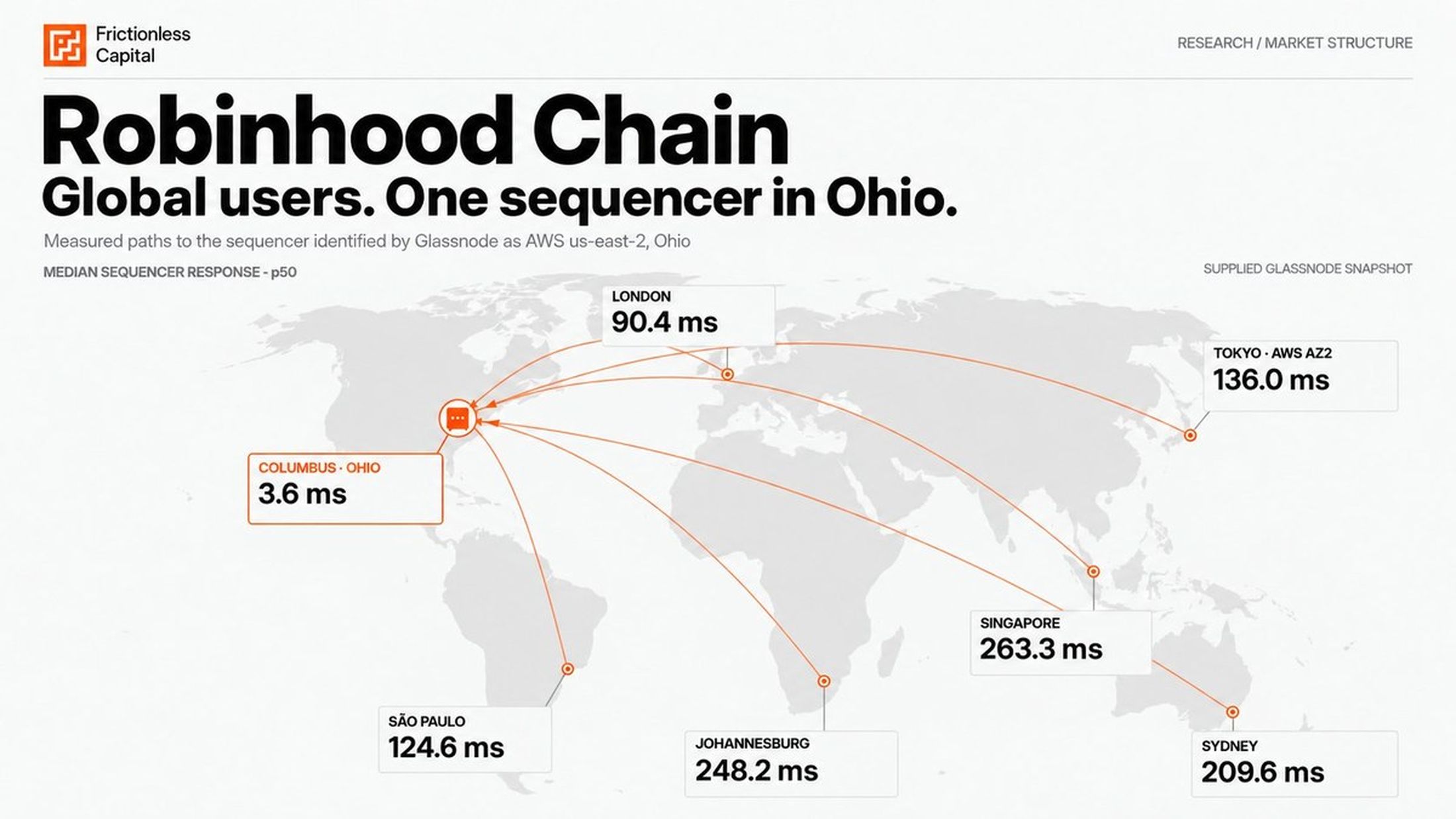
Supplied Glassnode snapshot of median sequencer submission-response times. These are not trade execution or finality times.
These are different mechanisms. Buying a fast lane is not the same thing as physically colocating. But they all give trading firms a reason to care about how their transactions reach the infrastructure that orders them.
You can imagine, and already see this playing out in real time, that as any one of these venues starts to get real trading volume, market makers and trading firms want an edge and will try to physically colocate as close as possible to make as much money as possible. As they should.
This is the standard playbook for how finance has evolved over many decades. Get close to the matching engine, get predictable latency, reduce jitter and compete to be first.
You can see a similar dynamic with Hyperliquid. It has its own validator set instead of one corporate sequencer, but the validator infrastructure as observed by Glassnode is concentrated in the Tokyo metro area.
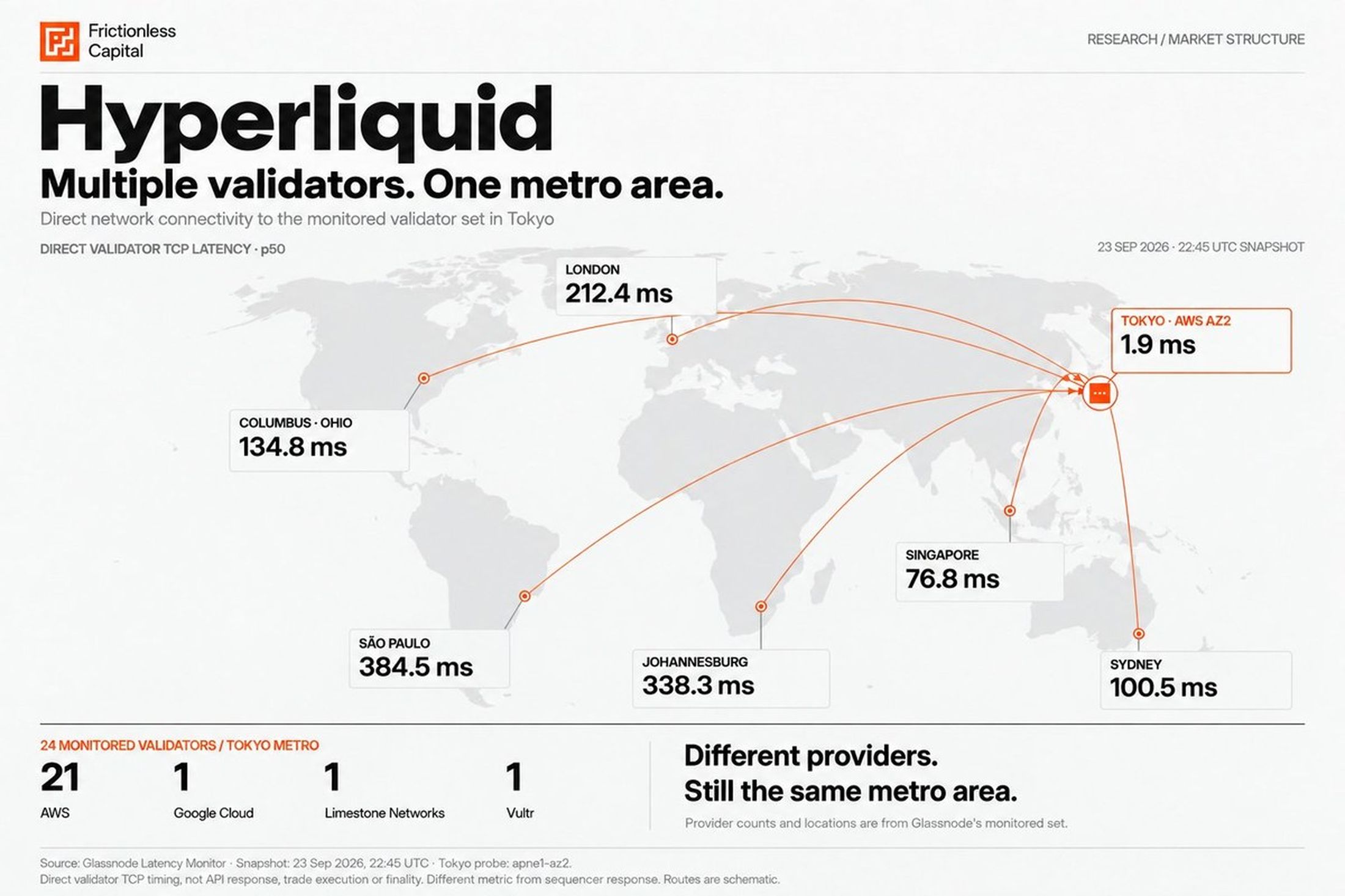
Validator set as of September 23, 2026. Direct TCP latency, not execution or finality.
If you are a market maker competing on that venue, where are you going to want your servers? As close to that infrastructure as possible. Again, this is exactly what rational trading firms should do.
The question in my mind has always been are we just copying TradFi market structure or is there a better way if we are truly going to build better global internet capital markets?
If you think about what actually moves markets, new information is being created around the world all the time. The Fed changes policy in the US, the BOJ makes an announcement in Japan, or a company releases earnings in Europe.
Algorithmic traders and event driven traders react to that information. They update their prices, cancel old quotes and take new positions based on what they have learned. That activity creates order flow, which is how the new information gets priced into markets.
My question is why does all of that order flow needs to race back to one physical location before it can enter the same market?
Even if your users are global and the events moving prices happen around the world, the market still has a physical center that everyone optimizes around. Ohio, Tokyo, New Jersey, wherever the infrastructure happens to be.
This is what I find interesting about multi-leader / multi-proposer designs as one example. What if instead of every transaction having to race to one location first, you could have multiple proposers taking in transactions at the same time in different parts of the world?.
You could capture order flow close to where it originates. Participants in Asia could enter through Asia, participants in Europe could enter through Europe, and participants in the US could enter through the US.
Imagine a trader in Tokyo reacting to new information. Their order could reach a nearby leader while a message sent from the same location at the same time toward NYSE in Mahwah is still traveling across the world.
That gap is a local intake window.
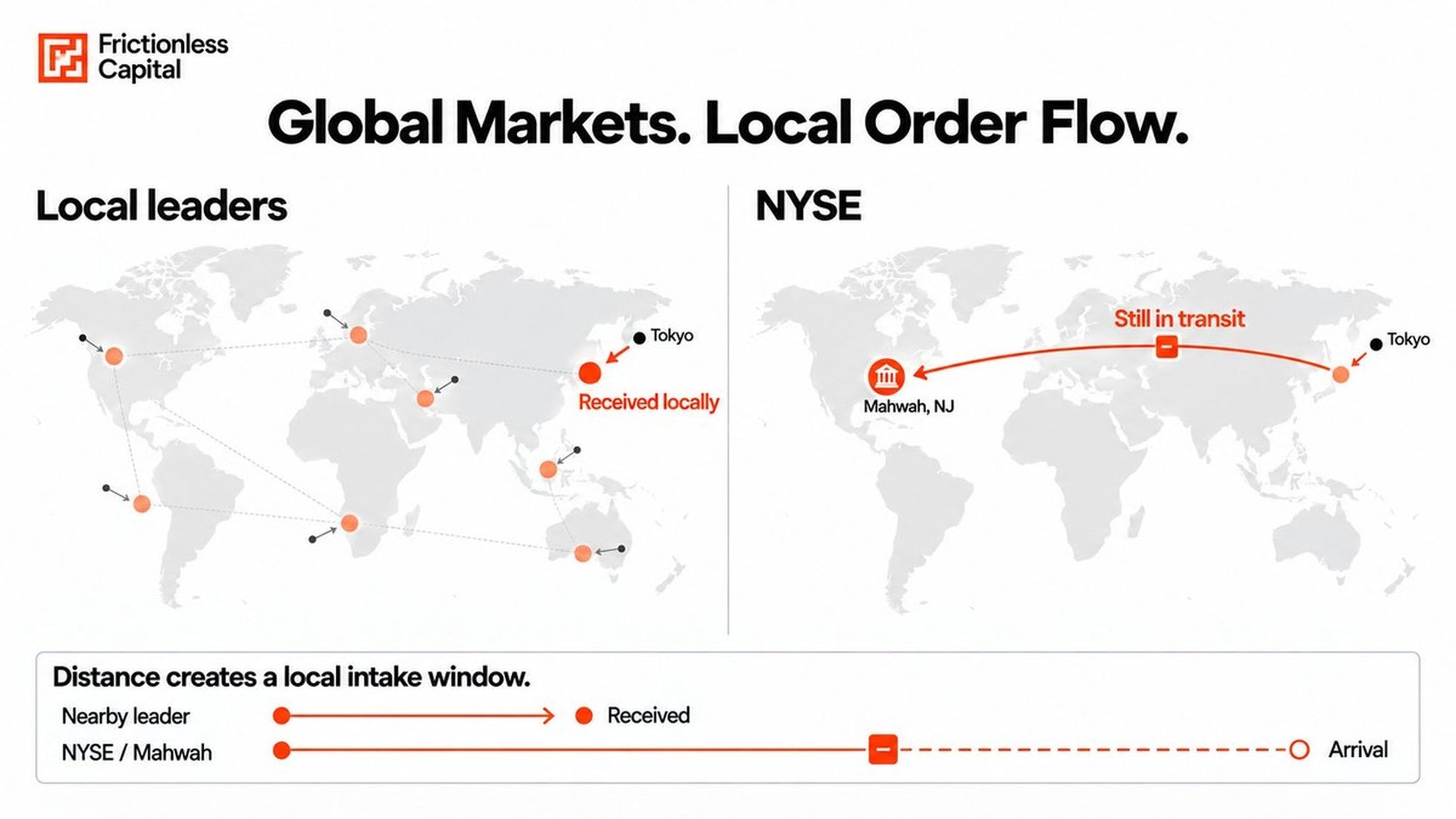
The nearby leader can receive that order flow before the distant venue receives the message. Not because anyone escaped physics, but because the first destination is closer.
Then the network brings that activity together under shared ordering rules so it can contribute to price discovery in the same global market.
If this works, the benefit could be better global price discovery. Information reflected in trading activity around the world could enter the system locally, instead of everyone first competing to reach one distant matching engine.
You obviously dont get to escape physics. Those locations still need to communicate and agree on what happened, and taking an order in locally is not the same as that order being globally confirmed.
There are still real questions around ordering, fairness and how competing transactions get resolved. But capturing order flow locally and using it to discover prices globally is the opportunity I think is worth exploring. You potentially give participants more places to enter the same market and reduce their dependence on one physical location.
This is also why DoubleZero and multicast (I'll write more about this another time) is becoming interesting. Multi-leader changes where transactions can enter, while the network underneath helps move that information between those locations.
The Total Addressable Market of Global Finance
Which gets into the second issue, the total addressable market of global finance.
Onchain capital markets are still small relative to the global financial system. But I dont think we should measure the opportunity only by the activity that already exists onchain today.
The prize is all of finance. Equities, bonds, currencies, commodities, derivatives, lending and payments. Not just building better products for the people already using crypto, but building products and infrastructure that give the rest of the financial world a reason to come onchain.
Today financial institutions and exchanges operate across different databases, rules and infrastructure. If we are serious about bringing more of that financial activity onchain, I think the opportunity is to connect those systems so assets, exchanges, lending markets, payments and applications can interact with the same shared financial state.
That is a much bigger ambition than building one exchange that happens to have users around the world.
And this is why the market structure matters. If the opportunity is global finance, then we should be thinking about how participants around the world enter the market, how their local information contributes to global price discovery and whether they need to colocate around one physical location to compete.
For that to work, institutions in different parts of the world need a reason to trust the infrastructure. Who can participate? Who decides what gets included? Who can change the rules? And how dependent is everyone on one operator or one jurisdiction?
Having more validators by itself doesnt answer those questions. But I think having infrastructure distributed across participants and jurisdictions, with credible shared rules, matters if the ambition is to build something the world can depend on.
This is where the two connect. Better market structure can create better products, and better products can bring more financial activity onchain. The market we are serving today is small compared to the market we could eventually serve.
Hyperliquid has built a great product. Having the validator infrastructure concentrated in Tokyo can make a lot of sense for the product they are building.
My question is what the end state looks like if the ambition is to house global capital markets, not just compete for the activity that is already onchain?
Are we going to recreate the same market structure we already have, with everyone racing to colocate around a handful of physical locations? Or can we use distributed systems to capture order flow where it originates, bring that information together and discover prices in a shared global market?
I think the second path is worth spending a lot more time on.