Backpack: the Tokenization Engine of Internet Capital Markets
Backpack, the Engine of Internet Capital Markets
The United States is in early stages of exporting its capital markets over the Internet. Over the past decade, we have watched this play out with the US dollar. We now believe Backpack is the company best placed to carry the banner on exporting US capital markets.
On June 12th SpaceX went public. It was the biggest IPO ever recorded, with $75 billion raised. Almost immediately, tokenized shares of the company, $SPCX issued by Backpack and redeemable 1:1 for real shares were available for trading on a blockchain rail that allow them to be accessible and tradable by anyone in the world. When the market closed, $SPCX became the means of primary price discovery as shares traded straight through the weekend while Nasdaq was closed. That Monday, SpaceX opened trading on NYSE just basis points from where Backpack’s tokenized SpaceX shares had it trading on the blockchain, and Backpack tokenized SpaceX would go on to do $1.08 billion of volume in its first month. This is not a crypto or weekend trading story, it is a story about the start of the United States exporting its capital markets in the same way that it exported the dollar with stablecoins. It is our strong belief that Backpack is positioned to be the global leader in this category.
Stablecoins are a Checkmate Win for US dollar Hegemony
Over the past five years, America has begun to put US dollars onto the Internet via companies like Tether and Circle. $300 billion of digital dollars are now used by ~300 million people in developing countries as a savings account, because their local currencies are worse. The genius of Tether and Circle was realizing people have a voracious demand for dollars, and positioning at the mint & redeem gate allows you to monetize the issuance float.
At the beginning the United States government watched dollars become tokenized over and accessible globally on the Internet and admittedly was very skeptical, but doubt soon turned into overwhelming support once they started to see that these entities become some of the largest buyers of Treasuries globally. Over 5 years, Circle began to tokenize other currencies as well, but found limited traction as patrons around the world want access to the dollars to limit inflation and the most universal acceptable currency. Over time dollar denominated stablecoins like USDT and USDC helped the United States achieve the vast majority of market share in digital currencies. In a short period of time dollar denominated stablecoins are growing at a staggering pace.
99.4% market share of the stablecoin market
$33b in US Government debt purchases, more than Japan, and 3x more than China
$30 trillion in payment volumes in 2025
The reality of the matter is that people abroad much preferred to hold dollars instead of their local currency, which could be seized, or printed away overnight. In response to calls to lay out a clear regulatory framework, the United States passed the Genius Act, legalizing stablecoins as long as they are backed 1:1 by real dollars held in a US domiciled bank account. On August 17th, 2026, Treasury Secretary Scott Bessent took things a step further by announcing the Treasury Department had begun treating stablecoins as strategic dollar infrastructure, allowing them to extend dollar hegemony like Eurodollars.
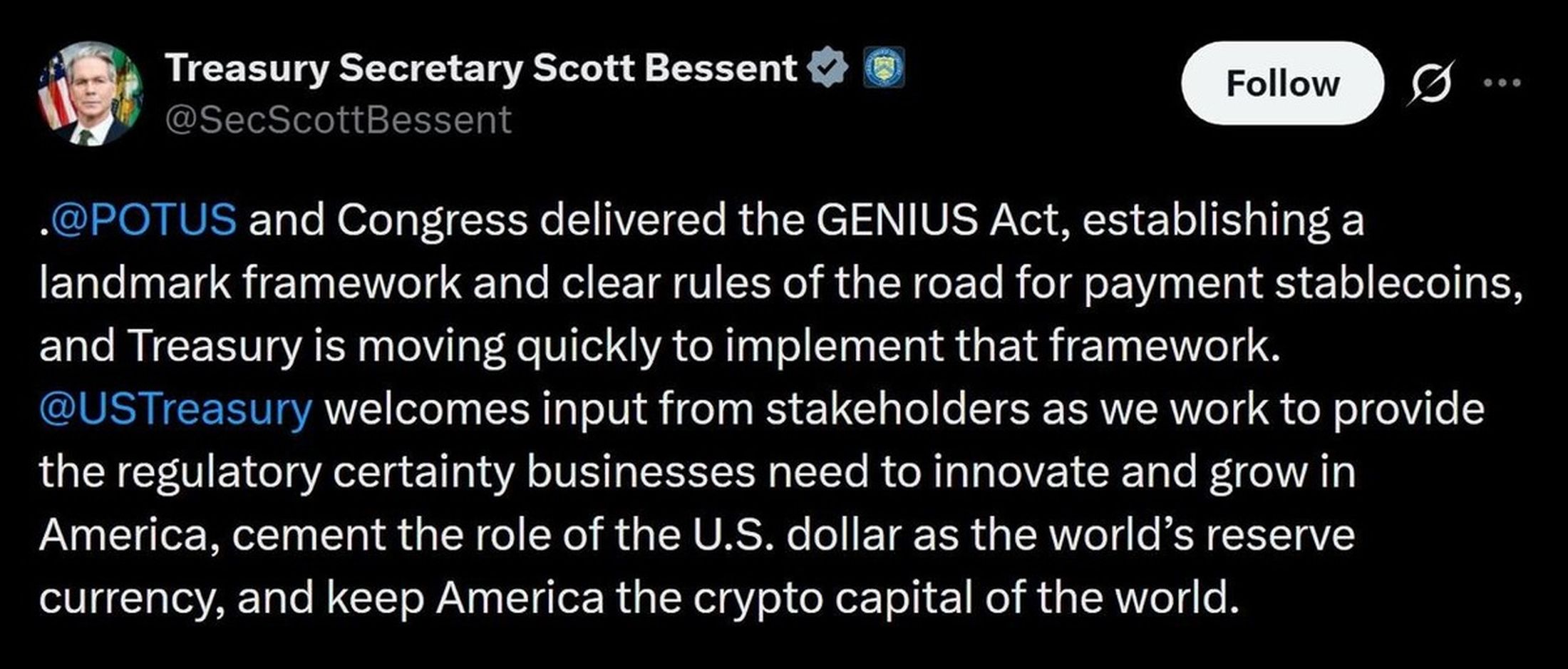
This marked the final act in dollarization regulation. The dollar export worked so well now America is exporting an even larger product: Capital markets, and the full spectrum of securities, starting with US equities.
The Stablecoin Playbook is Being Applied to US Equities Via Tokenization
Just as people much preferred to hold digital dollars over their local currencies, people generally much prefer to hold tokenized US equities and there is now the opportunity for anyone with access to the Internet to own the best and fastest growing companies in the world. By already dollarizing 150+ countries and over 300 million people with stablecoins, people have dollar savings accounts funded and ready to purchase equities (which of course are dollar denominated). The argument of why people choose US equities is clear. US stocks account for 52% of all earnings and the majority of the growth, and there is a historic pipeline of companies heading to IPO over the next 12-18 months including the major AI model companies (Anthropic, OpenAI etc.) and related infrastructure & hardware businesses. The ability to distribute equity and capture demand to all countries via tokenization on the blockchain becomes even more interesting when you consider that the main brokerages in China, Futu, Longbridge, and Tiger Broker, have effectively banned dealing in US equities. Similar to capital controls with local currencies, the demand for US dollars (and equities) will not get deleted, it will simply get displaced onto new rails, and this trend will only accelerate the adoption of tokenized stocks. This is the most significant expansion of American financial power since SWIFT, and we are in the very early stages of it.
On the regulatory front, the foundation and precursors to the Genius Act for equities have already happened. First, the SEC and the CFTC merged their crypto work into a single effort. The SEC approved Nasdaq's tokenized trading pilot in March. On September 1st it proposed letting the official record of who owns a share sit on a blockchain, the first serious rewrite of those rules since the 1970s. On September 17th, the SEC and CFTC deregulated tokenized stock trading, allowing these instruments to be traded in permissionless pools such as AMMs on the blockchain, and relaxed rules for propAMMs and applications to register as exchanges or brokers. These innovation exemptions effectively pave the path for US stocks to trade on the blockchain for the next 5 years at minimum. The reasoning is the same as stablecoins, tokenized shares never actually leave America. US stocks are required to stay with a US broker, under New York law, inside US custody. Buyers worldwide get the exposure, and overnight the United States just expanded its capital markets hegemony to a hundred and fifty countries it could never practically serve before.
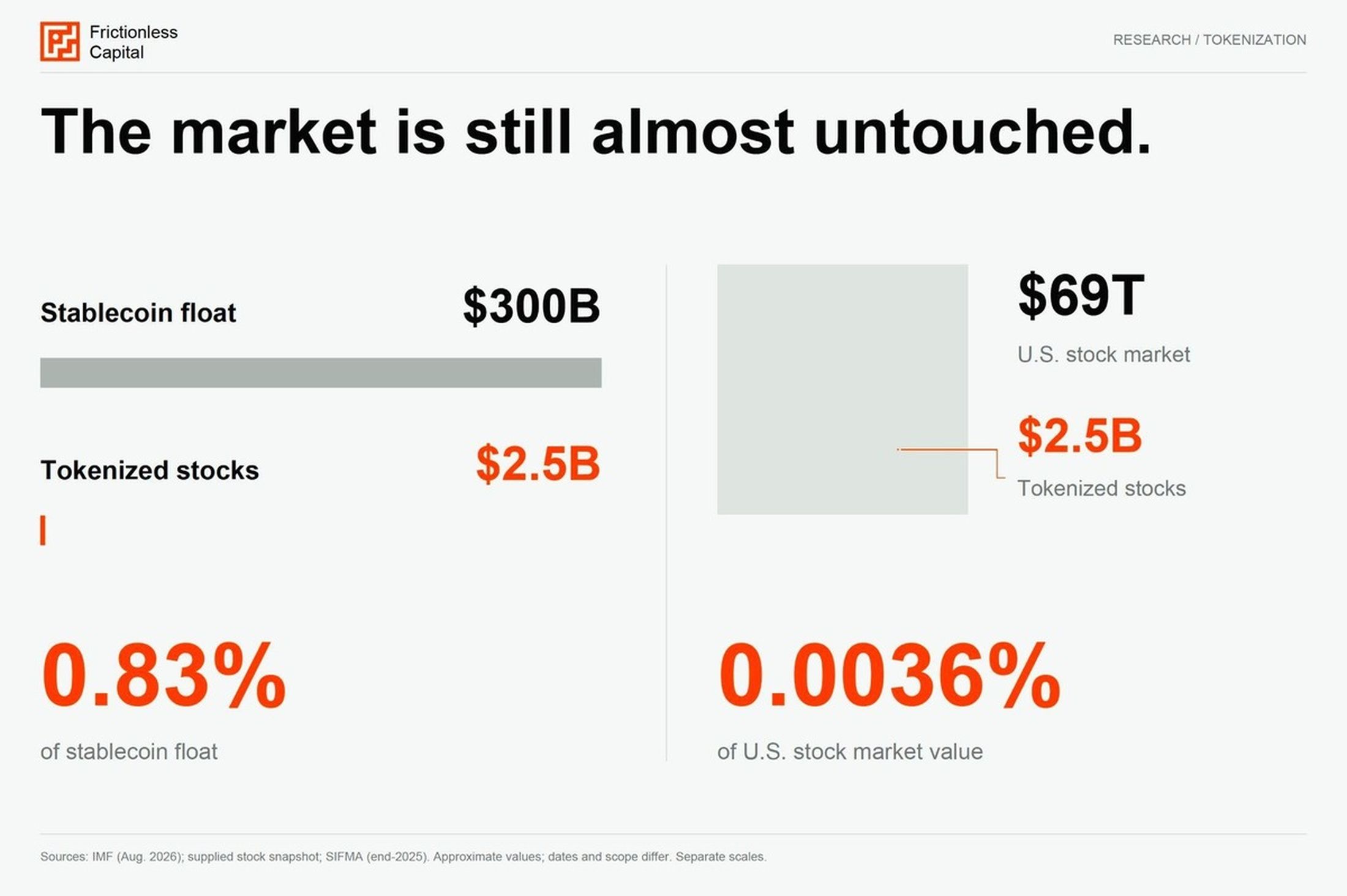
Digital dollars already minted: roughly $300 billion. Every tokenized share on earth: roughly $2.5 billion, under 1% of that. The American stock market: $69 trillion, tokenized stocks are less than 0.01% of that value!
So if this is the game, who are the players and how will they get paid for winning?
By creating a 100x larger distribution funnel for anyone with an Internet connection, tokenized stocks are poised to be one of the biggest opportunities in all of Finance over the next couple of years. When we study how the race happened with the dollar, Tether and Circle show that it was the people who owned the mint and redeem function that reaped most of the revenue. It wasn’t the trading or payments, it was the licensed players that controlled the gate. The choice to position the company at the door where minting and redemptions happen turned Tether into one of the most profitable companies per employee in history. The asset export of equities will do the same thing for whoever runs the equivalent door for American shares.
Today, Backpack is a leader in the race to tokenize securities. There are 4 reasons why Backpack is winning and will continue to dominate the export of US capital markets, which is one of the largest opportunities in all of Finance.
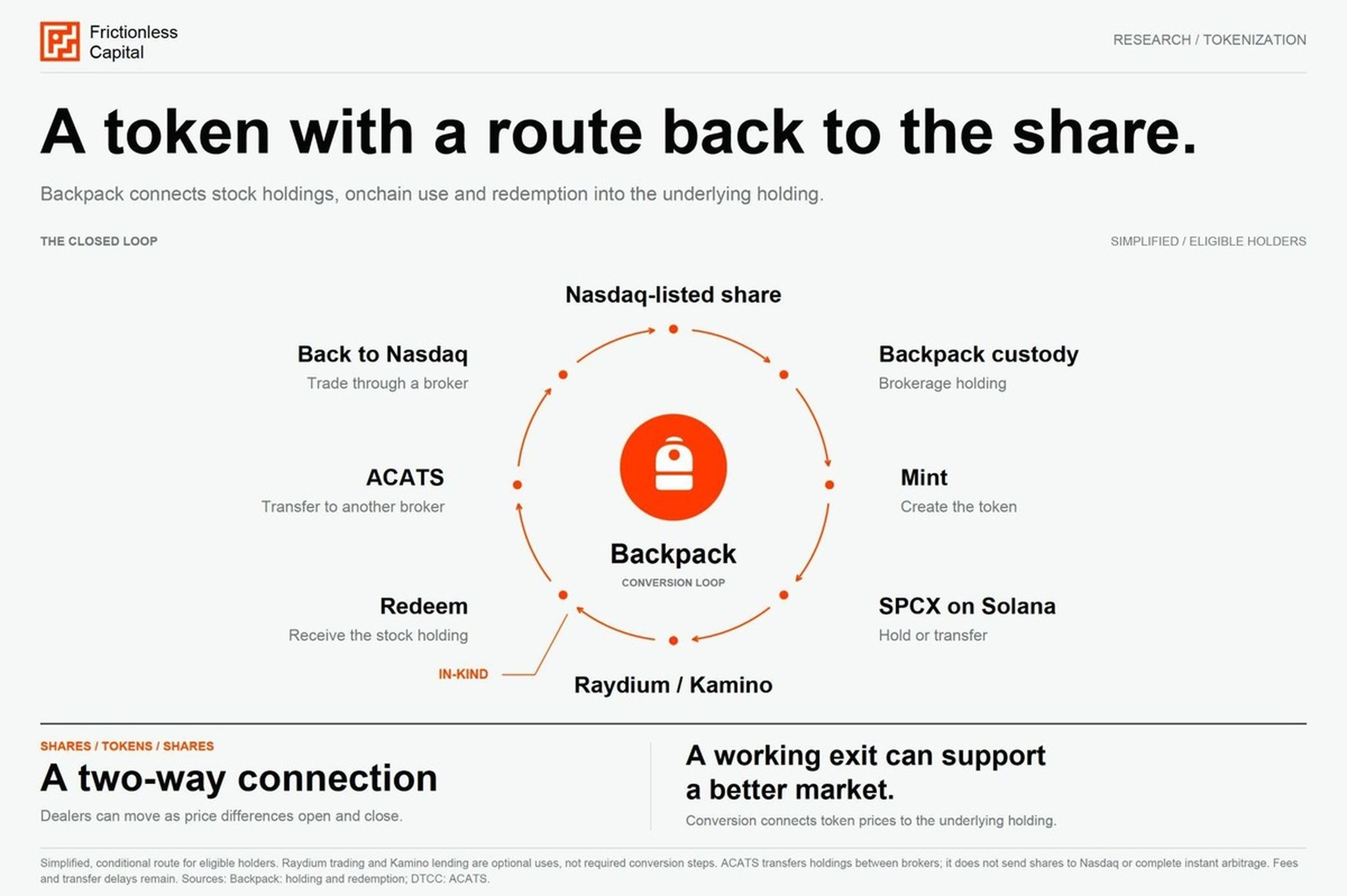
Thus far, all attempts at tokenized stocks have been cash settled, in other words when you want to exchange a tokenized share of Nvidia, you don’t get $NVDA class A common equity, you get the equivalent amount of cash that it’s worth at that point in time. There are a couple very significant problems to this approach, first of which being that you don’t actually own the shares if you can’t exchange the tokenized stocks for real shares, you own claims against an offshore SPV without full rights and representations. Furthermore, cash redemption is a taxable event, whereas in-kind redemption (as pioneered by Backpack) does not trigger a tax liability, as you are not selling into cash but rather exchanging a tokenized share for a normal share. This may sound like a legal brainteaser but the effect on trading volumes and market structure is absolutely massive.
Backpack (in-kind redemptions) holds about 4% of all the tokenized stock in existence and does 64% of the trading, without incentives. Its biggest rival xStocks (cash settlement) holds 68% of the stock and does less than half of the volume.
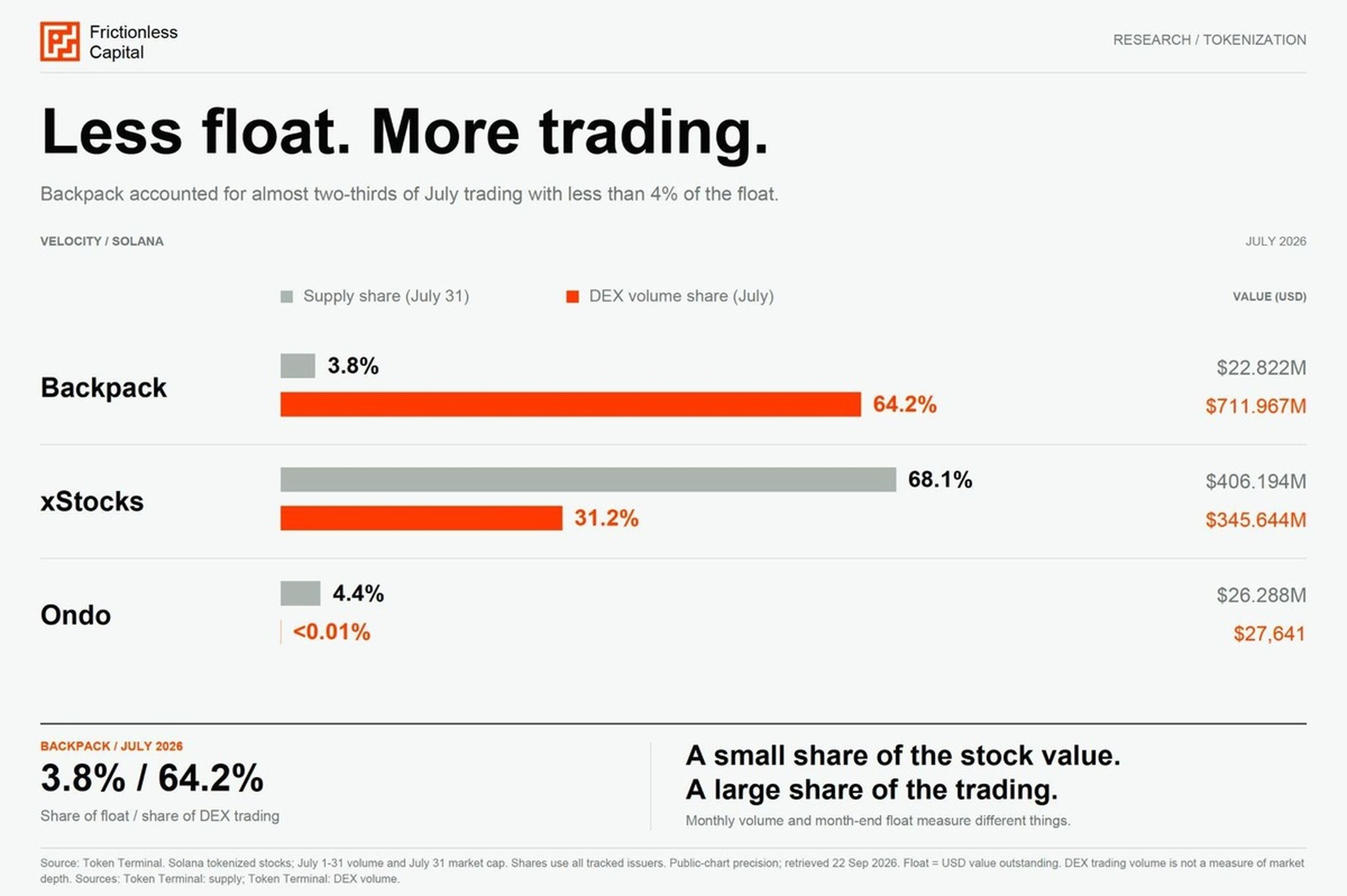
So how is it possible that each dollar parked at Backpack works 30-1,000x harder than xStocks and Ondo? Start with the fact that Backpack ships real shares rather than cash-settled receipts. Behind every Backpack SPCX token sits an actual SpaceX share, held at a US regulated broker, owned by you under New York law, with the dividends attached. Hand the token back and you can take delivery of the real share and move it into an account in another brokerage without triggering a tax event. SpaceX tokens by competitors give you the price and nothing else, because your claim runs against a shell company in Jersey. You cannot transfer them to another broker because you don’t own the underlying shares.
This may sound like a legal technicality until you see what it does to the market. When you can swap tokens for real shares, you can’t get stuck holding onto a piece of paper that entitles you to a certain amount of cash. Market makers already hold shares on brokerages, so if you give them a system that allows them to seamlessly move fungible units of risk across their aggregate exposure, they will be able to quote much tighter spreads and deeper liquidity without being at risk of losing large sums of money. Phrased differently, when you can swap tokens for real shares whenever the price drifts, redemption risk is collapsed. The price on the blockchain cannot wander very far from Nasdaq, because wandering becomes free money for anyone holding the swap right, and sophisticated traders can mint and redeem to arbitrage prices back into line. This is why S&P 500 funds trade within a penny of what it holds.
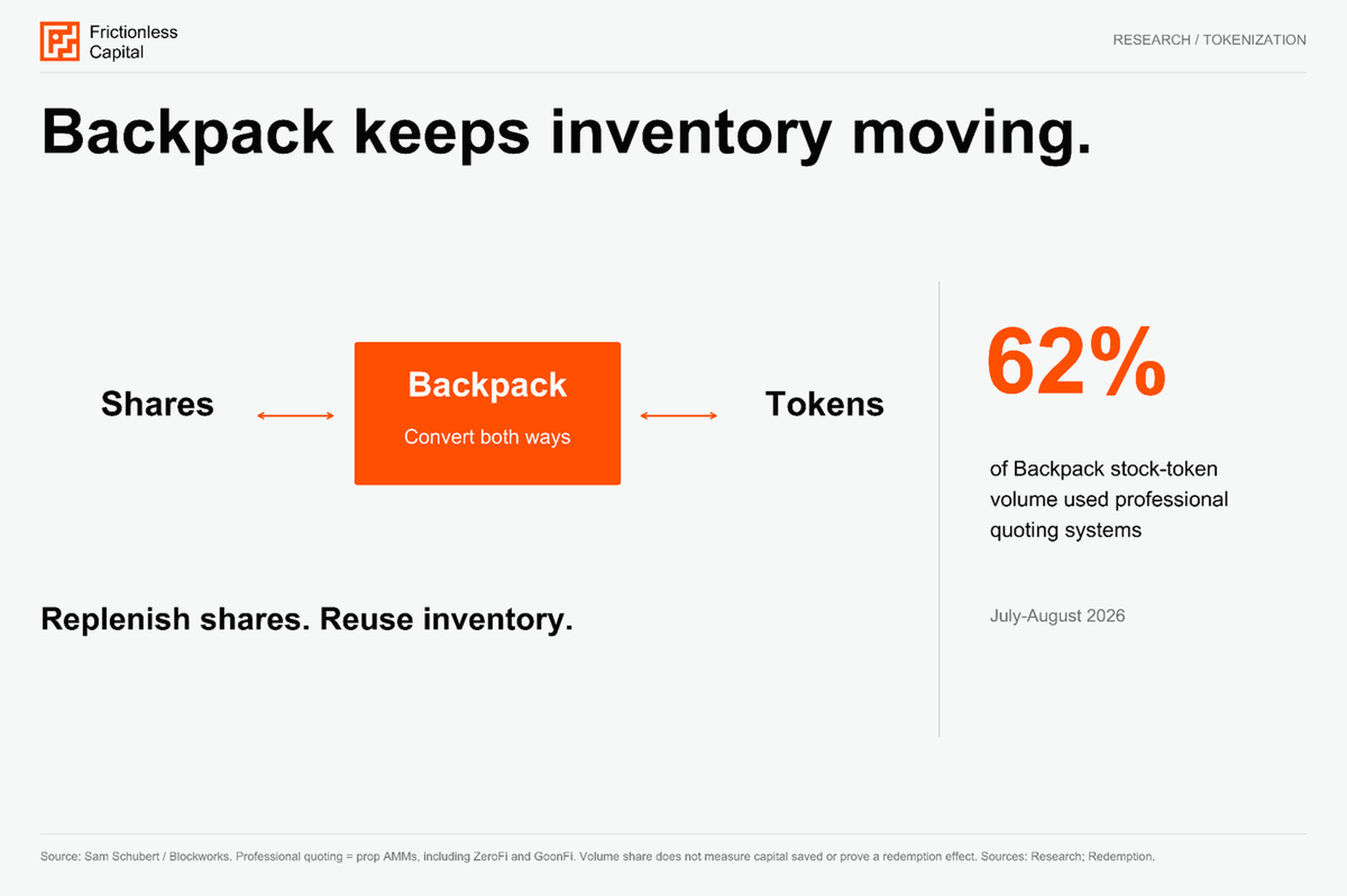
So clean redemption mechanics and cheaper trading pull volume, volume pulls more trading firms, those firms quote tighter, and tighter quotes pull more volume again. That is the engine, it compounds, and it is why Backpack, a company with 4% of the stock already does two thirds of the business. This seems simple, but this didn’t happen overnight. Backpack has access to a US Broker Dealer and went the licensed path first and built a product that enables this seamlessly.
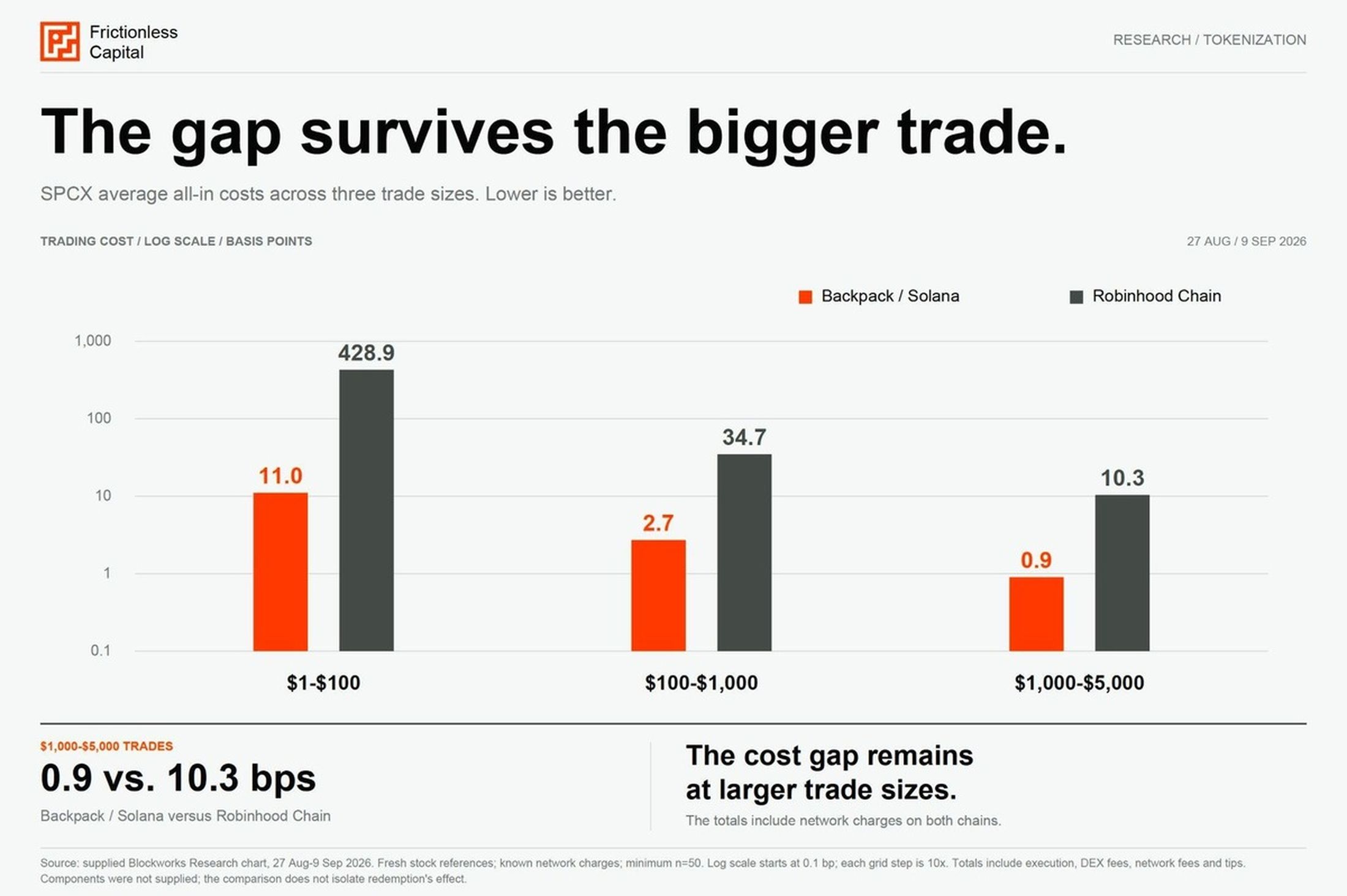
When you look across the landscape, the results are astounding. Trading in Backpack Securities tokenized stocks is also about eleven times cheaper than on Robinhood chain. Blockworks Research priced two weeks of real orders in September. A trade of $1,000 to $5,000 cost 0.9 basis points on Backpack against 10.3 on Robinhood's own chain, a basis point being one hundredth of one percent. On small orders the gap is 11 bps (0.11%) against 428.9 bps (4.29%).
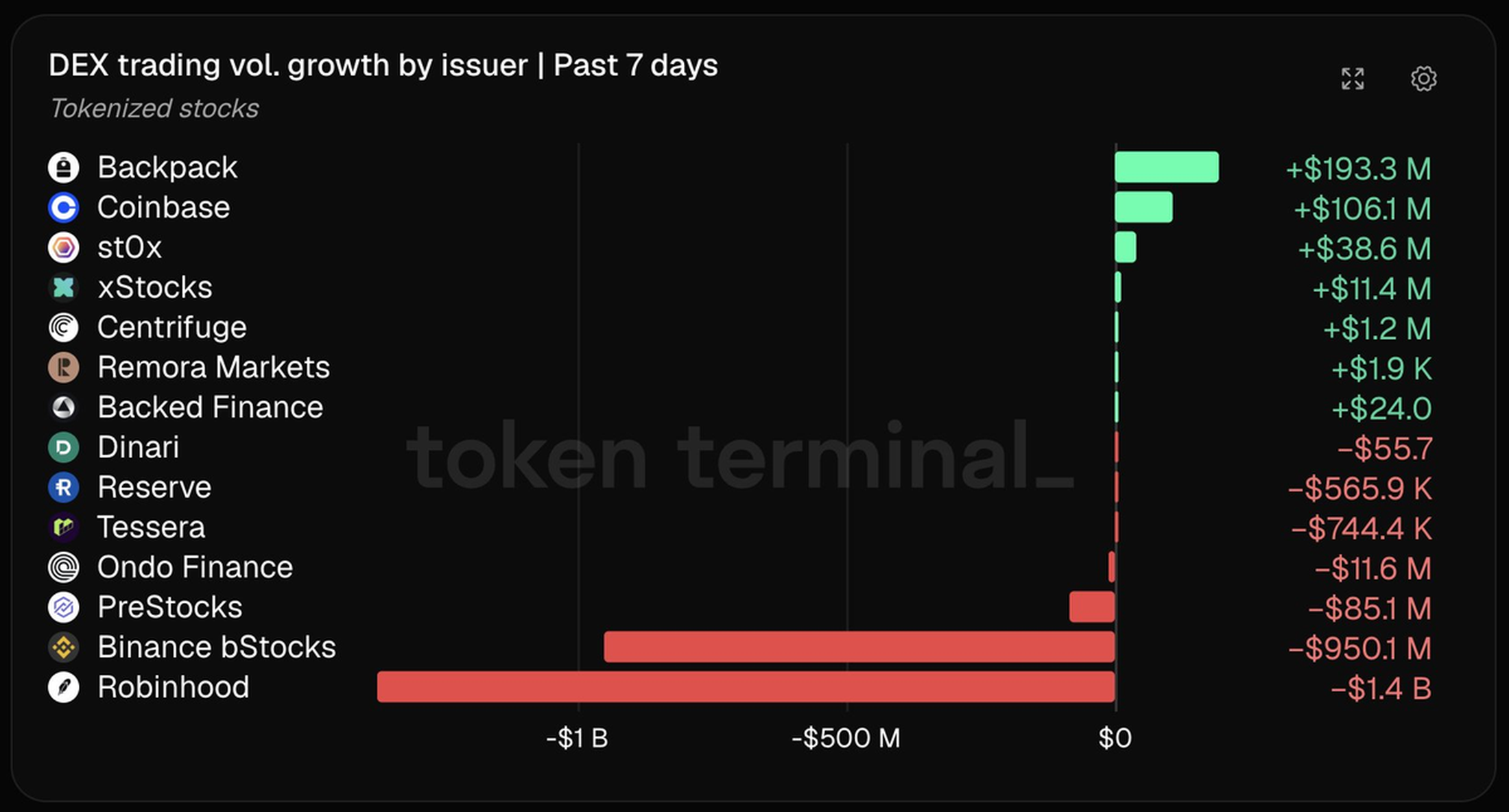
Money notices discrepancies like that, and markets move quickly following the path of least resistance and friction. In one recent week (Sept. 18) Backpack added $193 million of trading volume while Robinhood lost $1.4 billion and Binance's version lost $950 million.
However, there is another reason why Backpack is leading tokenization, and it’s one that is not easily replicable by other companies.
Backpack Offers Unified Margin Across All Assets, Including Stocks
One thing is being able to mint and redeem shares with the cleanest redemption architecture, but once shares exist, the question begins to be, what can you do with them beyond just trading. On Backpack, you can do much more with your shares as collateral than anywhere else in the world. If you open an account almost anywhere else and your money lives in separate boxes. Shares sit at a broker. Crypto sits at an exchange. Stablecoins sit in a wallet. Futures sit in their own account with their own cash. Every box carries its own collateral and its own idle balance, and moving between them takes days. In other words, none of your money or assets talk to each other and you are forced to use 5 or 7 apps to manage your finances.
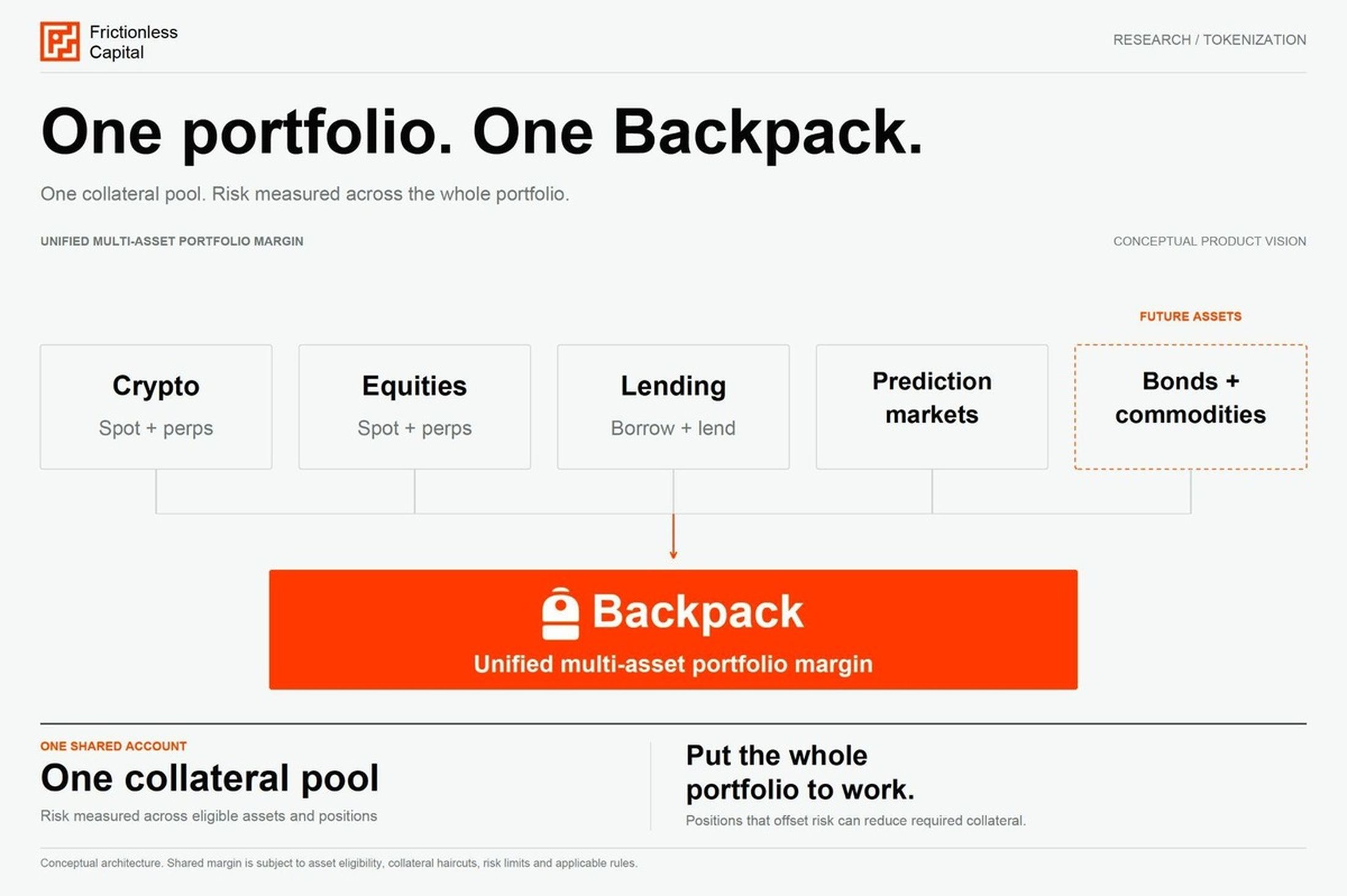
Instead, Backpack runs one account with one pool of collateral behind all of it. Your Nvidia shares can be used as margin for a Bitcoin trade. Your unrealized profit earns lending yield while the position is still open. Your stablecoins can be borrowed against without being sold. Nothing has to be sold, wrapped or moved before the next trade happens. This is something no American bank or broker can offer, and there are legal reasons why this is the case. US law spent fifty years splitting the job across an exchange, a clearing house, a vault, a transfer agent and a broker, each a separate regulated firm, every incumbent inherited those walls. Backpack was built without them from first principles to enable a net better product for users.
The same idea is now being pointed at liquidity. A share of Nvidia trades in one pool in New York, another in London, a tokenized version in a third pool on a chain, and a futures contract somewhere else again, each holding its own capital and none of it aware of the rest. Backpack is pulling them into a single order book internationally where the share, the token, the future and the stablecoin paying for it all clear against the same collateral. Instead of having to split liquidity split five ways, Backpack is building a supermassive tokenization complex with total capital efficiency and control over your assets.
While other exchanges were playing regulatory arbitrage games by evading KYC for as long as possible, Backpack has been obtaining the requisite licenses to be able to support the export of capital markets and serve global audiences. This legal and compliance emphasis is now becoming increasingly obvious as the United States deregulated the trading of securities on the blockchain, and this is a core differentiator of Backpack versus other institutions who are trying to retrofit to capture the opportunity now.
Backpack has Deliberately Gone International First, and USA Last
The landscape of brokerages and exchanges is fragmented across regional players like Robinhood, Coinbase and Schwab which are American companies reaching outward, carrying American rules with them. Binance is an offshore company trying to get back into America. The Backpack approach has been very deliberate to be able to serve the majority of the world prior to returning to the United States. Backpack acquired its licenses in parallel rather than in sequence: FTX's European arm for $32.7 million and with it a MiFID II license, the same permission European banks hold to deal in shares, plus a full market license in Dubai, membership of Japan's exchange body, an Australian license, and a US brokerage wired straight into the American settlement system.
Its 24/7 stock product serves more than a hundred and fifty countries and is deliberately not offered inside the United States. That approach has some benefits that are not immediately obvious.
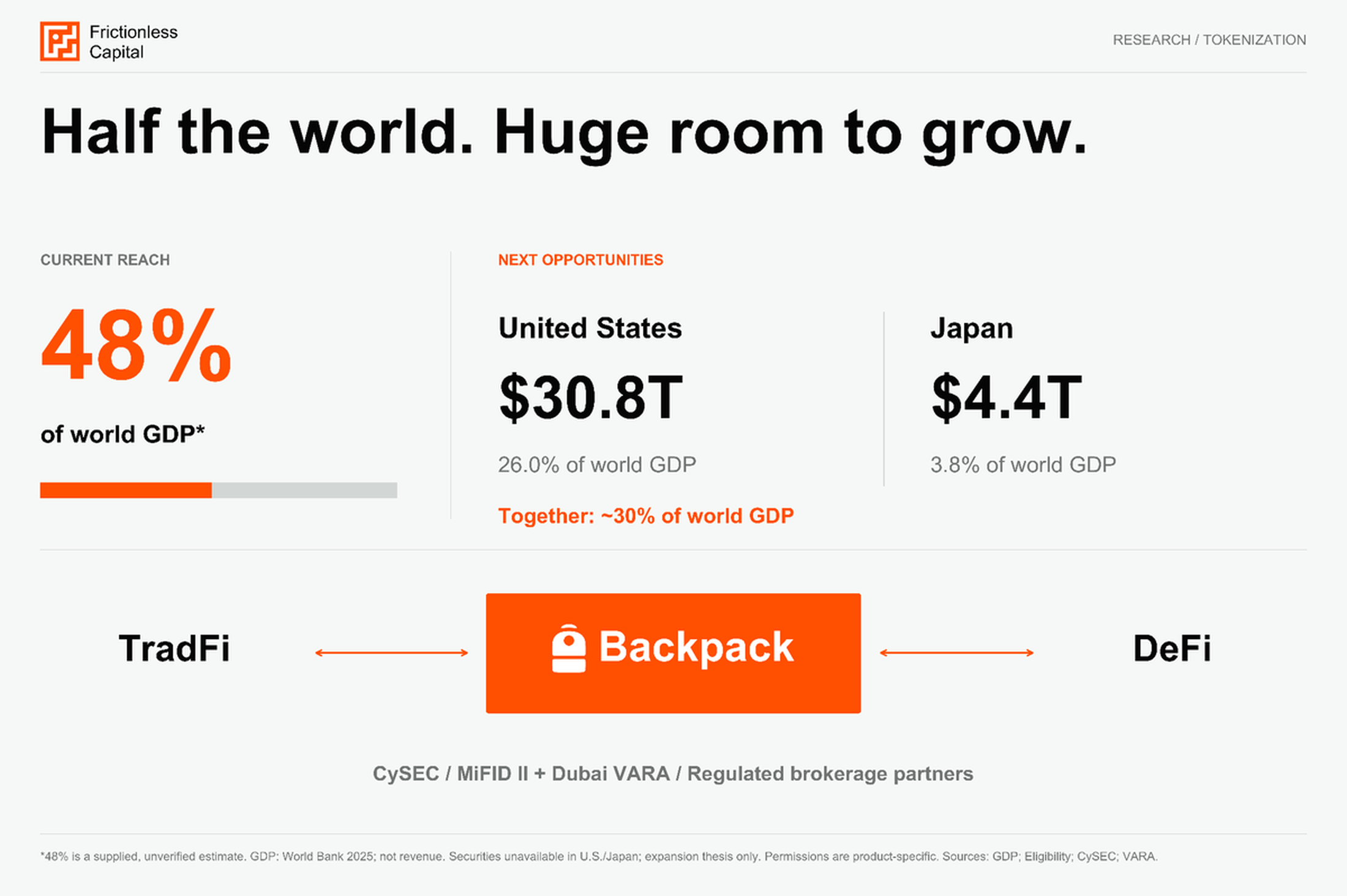
Backpack is only able to legally serve 48% of the world by GDP today, but that number is going to increase substantially with the addition of the United States and Japan, the world’s two wealthiest economies.
Fifty-five percent of tokenized stock trading now happens outside American market hours, which means most of it takes place when no traditional exchange is setting a price at all. That is a market which did not exist three years ago. Even as NYSE transitions to 23/5 trading over the coming months, there is still no spot 1:1 weekend trading offering to express a point of view while the market is closed.
Backpack's futures book being built before tokenized stocks is crucial because futures are what keeps the price live during those hours, because a futures contract produces a price around the clock and a round-the-clock price is exactly what a broker needs to value shares it is lending against at two in the morning on a Saturday. Every new stock futures listing now automatically unlocks the underlying share as collateral, and all 17 listed stocks were eligible by September 17th.
Backpack Has Built a Fully Integrated Tokenization Engine
One of the most important distinctions between the various tokenized equity issuers is the degree of verticalization they choose. Backpack combines securities issuance and redemption, a spot and futures exchange, and a self-custody wallet within one ecosystem. This means that Backpack can issue the token, provide a market for it and control the interface customers use to trade it and use it. There is a sequencing moat because without a futures book, there is no underlying price when the markets are closed. The ability to support a tokenized stock, end-to-end, from issuance, to afterhours trading in a single spot-futures margin account when the market closes is a unique offering in the market.
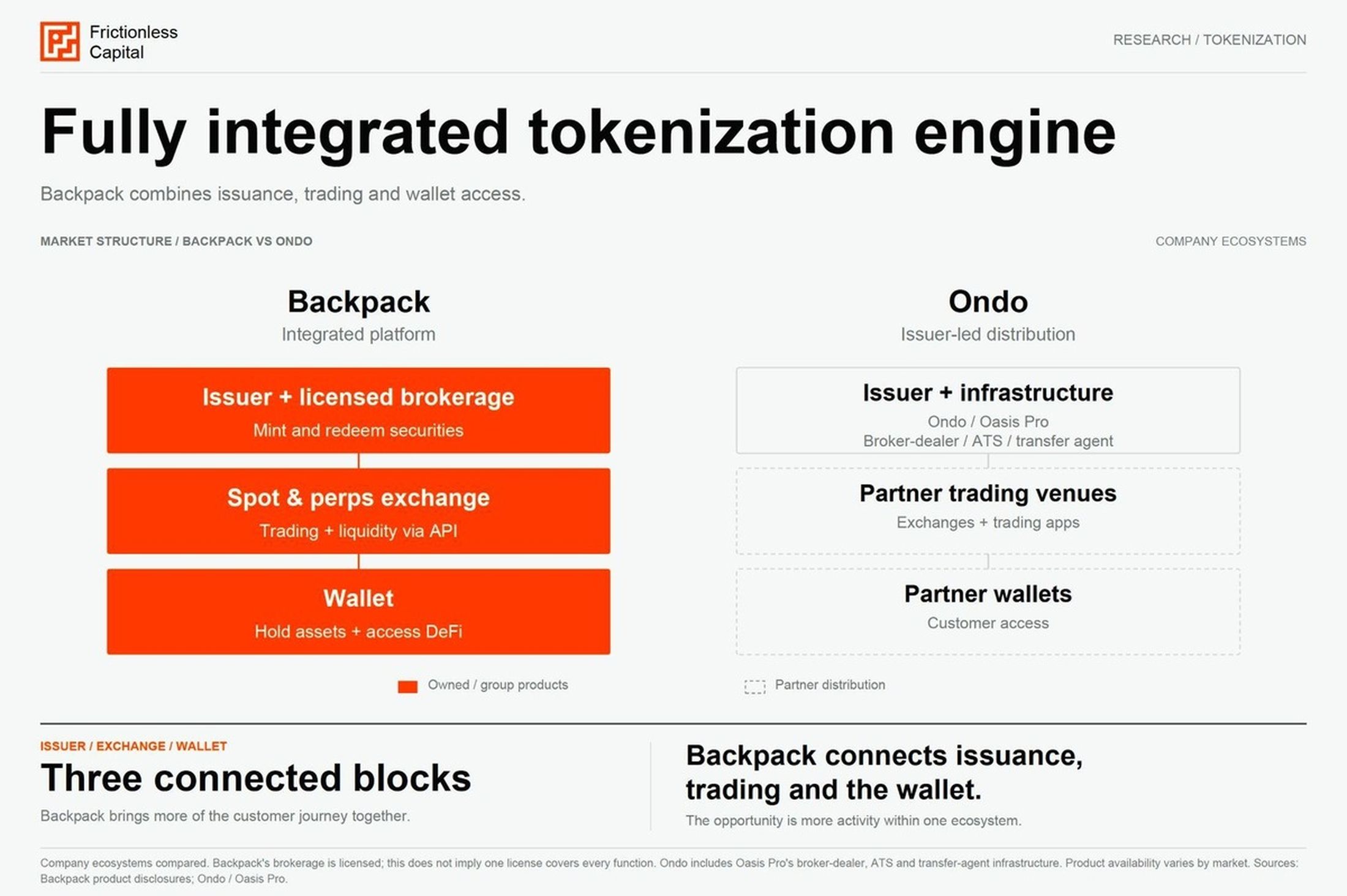
This is also reflected in the speed of integrations and listings. When you look at SpaceX's listing day, three issuers launched a tokenized SpaceX within hours of each other. Backpack did $37 million in its first seven hours and $108 million in the first day, and crossed 10,000 holders in six days, roughly double xStocks'. This was because Backpack only had to make one listing decision. Ondo had to make a decision and then coordinate listing with exchanges, DEXs, and wallet launch partners. In a market where every hour on listing day matters, minimizing the number of partners is key.
The blockchain is the final piece of that stack, and the only one Backpack had to choose rather than build. Solana has not only the most advanced trading market structure, but also is home to the vast majority of onchain application revenue in the industry. This means companies like Fomo, Pump, Phantom, and Raydium plug directly into Backpack’s minting and redemption out of the box and can use it to grow their businesses. Solana, as a platform, is doing more real transactions (excluding votes) than all other networks combined. This infrastructure already proved its resiliency in January of 2025 when $TRUMP launched, when Solana was able to process ~45% of a New York Stock Exchange trading session without any halts or without median transaction fees spiking. That is a level of battle-tested infrastructure that no other network has ever seen in the industry and is ideally suited to scale the distribution of tokenized stocks. The combination of a performant network with regulated tokenized issuance and trading front ends and apps that can acquire users with a UGC flywheel is a particularly powerful approach that is being validated in real time.
So Where Does the Market Go From Here?
It seems likely that two or three companies end up owning the key position for American capital markets securities exactly as Tether and Circle came to own it for dollars. That layer is a toll road. It earns from flow rather than float, but there is no question that it compounds with every new asset that crosses it.
Backpack is well positioned to be one of those companies, and on the current evidence today it is the largest in terms of price discovery and volume. It already does two thirds of the trading on less than a twentieth of the stock and it holds the licenses to sell into a hundred and fifty countries that the incumbents cannot reach without rebuilding themselves from the foundation up.
If that sounds like a large claim, it is worth remembering how the last American export of this kind (dollars) went: Stablecoins are the new Eurodollars and have speedrun $300 billion in float in less than a decade. Tokenized shares are the next leg, and they are at the $2.5 billion number today. It doesn’t take a genius (no pun intended) to know where this is going next. In fact, tokenized stocks are only Backpack’s first foray into the tokenization market, but the company possesses the licenses to take this concept far beyond just equities, and expand to commodities, FX, fixed income (bonds), structured products, or even real estate. With the dollarization process already deeply underway, and equities being much larger in terms of value than money supply, it seems likely the upcoming tokenization wave will be larger and more rapid than stablecoin distribution ever was.
To conclude, Backpack is not just building crypto or Fintech or an RWA protocol. We are at the dawn of exporting capital markets over the Internet and Backpack is positioned as the Tether or Circle of stocks, and has the licenses and product to seamlessly tokenize all other securities. The winners of this era will be less about the ones who marketed and tried to insert themselves into a narrative and more about being the player who tokenized all of Wall Street’s products, at scale, and with capital efficiency, and distributed them globally. Backpack has the license and compliance footprint and is generating the numbers to back this claim up. When we examine Fintech companies over the past 15 years, they largely rebuilt regional capital markets with better front ends on the same industrial era rails, but now the opportunity is much larger. In the era of Internet Capital Markets as put forth by the US regulatory posture, Backpack is the first company of its cohort serving global capital markets natively on Internet rails, to everyone with a phone. This part of Finance has never had a global tier before. Crypto is the technology that uniquely enables the natively global era of Internet Finance. This is a silent redrawing of the chessboard, a new game is afoot, and we are investing in the most interesting era of Finance and markets in human history.